

How much gold do you need in TBC Anniversary? The answer depends on your playstyle, raid goals, and how you manage early expansion spending. In this full 90-day breakdown, we model realistic gold requirements for casual players, active raiders, and hardcore min-maxers.
Gold in TBC Anniversary Is About Liquidity Timing, Not Scarcity
When progression realms move from Classic into World of Warcraft: The Burning Crusade, players do not start from zero. Unlike a brand-new server launch, TBC Anniversary inherits an existing economic foundation. Characters carry forward their accumulated Classic wealth. Guild banks enter Outland stocked. Some raiders begin the expansion with 3,000 gold. Others arrive with 8,000, 12,000, or even more.
Yet within weeks of launch, a recurring sentiment appears across nearly every server:
“Gold feels tighter than it should.”
This perception is not caused by reduced earning potential. In fact, Outland increases raw gold generation through higher quest rewards, improved farming efficiency, and stronger gathering yields. What changes is the structure of spending. TBC compresses multiple high-impact capital investments into the first 30–60 days of progression.
Flying mounts, profession leveling to 375, crafted pre-raid gear, raid consumables, reputation unlocks, PvP optimization, enchants, and gems all demand liquidity simultaneously. The issue is not that gold becomes scarce — it is that stored capital converts rapidly into semi-permanent assets.
For players looking at pure numbers, the TBC Anniversary Gold Cost Breakdown (2026) provides a snapshot of early spending exposure. However, understanding how much gold you actually need requires deeper modeling than simple totals. It requires understanding the expansion’s economic lifecycle.
The Four Economic Phases of TBC Anniversary
The TBC Anniversary gold economy moves through predictable stages. Recognizing these phases allows you to plan spending rather than react emotionally.
Phase 1: Pre-Expansion Speculation
Weeks before Outland opens, players reposition wealth. Herbs are stockpiled in anticipation of flask demand. Enchanting materials tighten in supply because new gear upgrades are inevitable. Crafting reagents begin inflating as players prepare to rush professions to 375.
This stage is expectation-driven inflation. Prices rise not because supply has collapsed, but because market participants anticipate synchronized demand. This behavior explains why gold can feel tight even before players reach level 70, a dynamic explored more deeply in Why Gold Feels Scarce on TBC Anniversary Servers.
The key takeaway is this: early inflation is psychological and anticipatory.
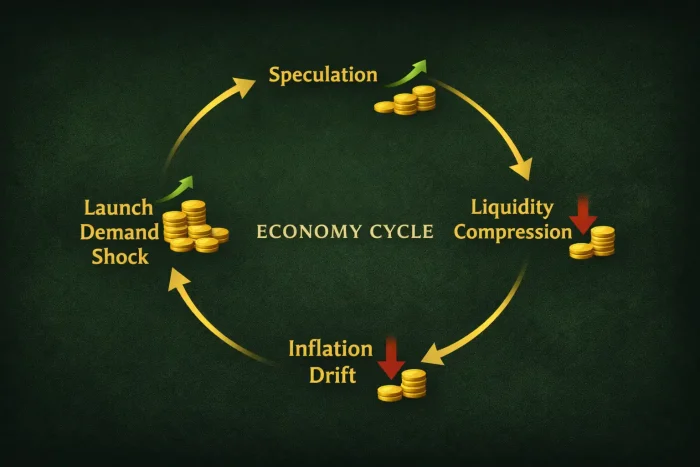
Phase 2: Launch Demand Shock
When the Dark Portal opens, demand becomes synchronized across the entire server population. Nearly every active player simultaneously wants to:
Reach level 70 efficiently
Purchase normal flying
Save toward epic flying
Level professions from 300 to 375
Craft pre-raid Best-in-Slot gear
Unlock heroic dungeon access
Stockpile raid consumables
High purchasing power collides with limited Outland supply. Fel Iron Ore, Adamantite Ore, Netherweave Cloth, and Primal elements become highly contested resources. Auction House turnover accelerates, but supply cannot immediately match synchronized demand.
This stage produces peak TBC Anniversary gold demand. Players often interpret this as “gold being harder to earn,” when in reality the server is experiencing compressed capital deployment.
Phase 3: Liquidity Compression
Liquidity compression is where perception diverges most sharply from reality.
Consider a raider entering TBC with 8,000 gold. That amount feels substantial in Classic terms. Within the first two weeks, however:
Normal flying absorbs roughly 1,000 gold.
Epic flying, if purchased early, consumes another 5,000.
Profession leveling may require 1,500–2,500 gold depending on timing.
Pre-raid enchants and gems add several hundred more.
Initial raid consumables begin recurring weekly.
Suddenly, 8,000 gold may fall below 1,000 in liquid reserves.
Total wealth has not vanished. It has converted into mobility, crafting capacity, and performance upgrades. However, liquidity — immediately spendable gold — has compressed.
This phase is one of the main reasons players begin researching the broader WoW TBC Gold landscape. The perceived shortage is tied to deployment speed, not earning difficulty.
Phase 4: Stabilization and Inflation Drift
After several weeks, the market stabilizes. Farmers optimize gathering routes. More players acquire epic flying. Auction House supply improves. Prices soften slightly from launch peaks.
However, long-term inflation begins drifting upward again as raw gold generation increases. More players at level 70 means more gold entering circulation. Daily quest loops and optimized farming increase total server liquidity.
Forecasting these cycles allows for strategic purchase timing, a topic analyzed further in TBC Anniversary Gold Inflation Forecast (Q2 2026).
Understanding this four-phase model is essential before attempting to calculate how much gold you actually need.
Capital Conversion Theory: Why Wealth Feels Temporary in TBC
To accurately estimate gold requirements, we must separate two concepts:
Total Wealth
Liquid Gold
Total wealth includes assets such as mounts, profession progress, crafted gear, and reputation access. Liquid gold represents immediate purchasing power.
In Classic, wealth accumulation often remains liquid. After epic mounts and raid consumables are covered, there are relatively few mandatory capital sinks. In TBC, wealth converts into semi-permanent assets quickly. Mount speed increases productivity. Professions unlock performance advantages. Crafted gear accelerates raid access.
These are rational investments. However, they reduce liquidity in the short term.
A player who invests heavily in epic flying and dual crafting professions may increase long-term earning potential while simultaneously reducing their ability to respond to unexpected expenses.
This liquidity-asset tradeoff drives much of the psychological tension inside the TBC gold market.
Players constantly balance:
Spend early for competitive advantage
Preserve liquidity for stability
There is no universal correct answer. The optimal path depends on playstyle, server conditions, and time availability.
Modeling Early Expansion Gold Requirements
Rather than asking “How much gold is enough?”, a better question is:
“How much liquidity do I need to survive the first 60 days without stress?”
To answer this, we must model spending across categories:
Mount training
Profession leveling
Pre-raid crafting and enchants
Weekly raid consumables
Reputation-related spending
PvP costs (if applicable)
The next sections will model each category in detail and then combine them into realistic liquidity ranges for different player types.
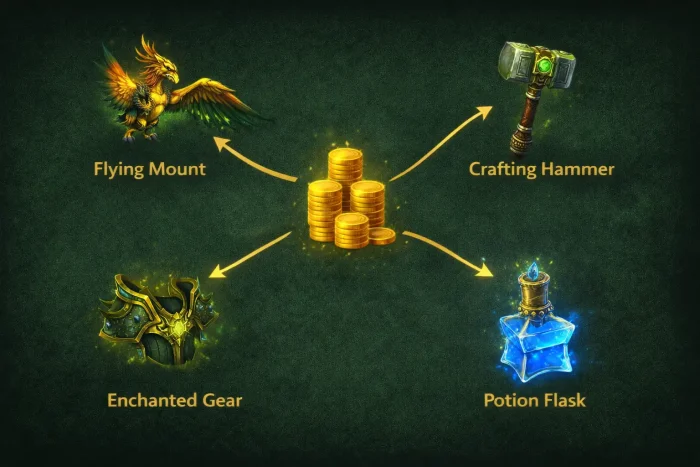
Mount Economics in TBC Anniversary: Mobility as a Capital Multiplier
Normal Flying: Baseline Economic Access
Normal flying, priced at approximately 900–1,000 gold, is the first major liquidity event for most players at level 70. Unlike ground mounts in Classic, flying in Outland is not simply a convenience. The zone design assumes vertical mobility. Herb nodes appear on elevated plateaus. Mining nodes spawn on cliff ridges and floating islands. Daily quest efficiency improves dramatically with aerial movement.
From an economic standpoint, normal flying removes inefficiency. Without it, farming routes are incomplete and travel time becomes a hidden tax on gold generation. While the purchase consumes a noticeable portion of early liquidity—especially for players entering with under 4,000 gold—it is not an optional luxury. It is foundational infrastructure for participating in the Outland economy.
Epic Flying: Return on Investment Modeling
Epic flying, costing roughly 5,000 gold for the training alone, represents the single largest early expansion investment. The question is not whether epic flying is powerful—it unquestionably increases productivity. The question is whether the return justifies the timing of the expenditure.
Let us model conservatively:
Farming yield with normal flying: 150 gold/hour
Farming yield with epic flying: 210 gold/hour
Productivity increase: 60 gold/hour
Break-even calculation:
5,000 ÷ 60 ≈ 83 hours
For a player farming 8–10 hours per week, epic flying becomes net positive within two months. For a casual player farming only 2–3 hours weekly, the break-even window extends dramatically.
On competitive realms, population density amplifies this advantage. Faster players reach nodes first, especially during peak hours. On high-traffic servers such as Spineshatter, monitoring Spineshatter Gold pricing trends often reveals sharper material inflation during early weeks precisely because epic flying concentrates gathering efficiency among early adopters.
A deeper cost-benefit breakdown is available in Epic Flying Mount Cost in TBC Anniversary, but the strategic takeaway is clear: epic flying is a capital accelerator. It increases earning ceiling while temporarily compressing liquidity.
Choosing when to purchase epic flying is often the defining decision of the first 60 days.

Profession Investment: Power Gains Versus Liquidity Stability
The 300–375 Investment Window
TBC transforms professions from optional crafting paths into competitive performance tools. Crafted sets such as Spellfire, Shadoweave, and Blacksmithing weapons can rival early raid drops. This shifts behavior dramatically. Players no longer level professions slowly; they rush to 375 during peak demand.
Material scarcity during the first weeks inflates costs. Fel Iron Ore, Adamantite Ore, Netherweave Cloth, and Primal elements become heavily contested. Leveling a single crafting profession realistically costs between 1,200 and 2,500 gold depending on server timing. Certain paths are more expensive, particularly Blacksmithing, as detailed in How Much Gold Does Blacksmithing Cost in TBC Anniversary?
Dual crafting can easily exceed 4,000 gold in early investment.
Crafting for Performance: Is It Worth It?
The economic logic behind early crafting lies in indirect returns. Strong crafted gear reduces wipe frequency, accelerates boss kills, and improves raid desirability. Fewer wipes translate to reduced consumable burn and repair costs. While this does not fully offset initial spending, it narrows the effective cost over time.
However, the liquidity impact is immediate. Players who combine epic flying with dual crafting in the first two weeks frequently reduce liquid reserves to near zero. That is not inherently wrong, but it increases exposure to unexpected expenses.
Players seeking more stable early gold flow often consult Best Professions for Gold in TBC Anniversary before committing to aggressive crafting paths.
Pre-Raid Optimization Costs: The Hidden Gold Layer
Beyond leveling professions, players incur additional optimization expenses:
Enchants for multiple gear slots
Gems for newly acquired items
Crafted filler gear
Rare recipe commissions
Enchant materials inflate sharply during synchronized gearing phases. It is common for a fully enchanted pre-raid character to spend 600–1,200 gold purely on optimization beyond crafting.
Gems further add to exposure, particularly in the first few weeks when Jewelcrafting supply is limited.
Combined, profession leveling and pre-raid optimization frequently exceed 2,500–4,000 gold for serious raiders.
This is one of the most underestimated components of early TBC Anniversary gold demand.
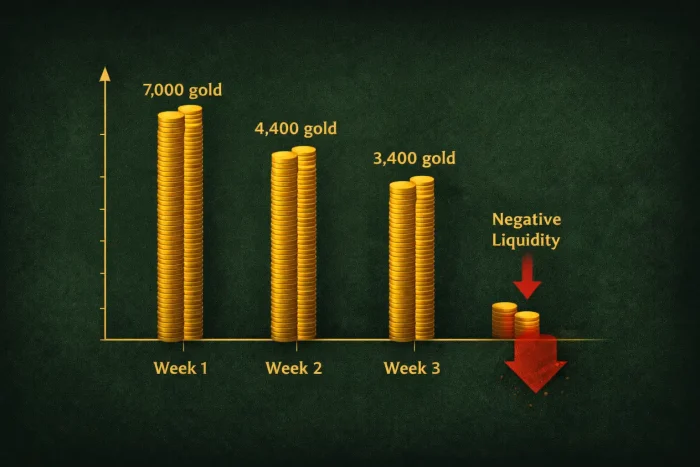
30-Day Liquidity Model: A Realistic Scenario
Let us model a balanced raider entering TBC Anniversary with 8,000 gold.
Week 1
Normal flying: -1,000
Remaining: 7,000
Week 2
Profession leveling (single crafting): -1,800
Pre-raid enchants/gems: -800
Remaining: 4,400
Week 3
Raid consumables (2 weeks @ 500): -1,000
Begin saving toward epic flying
Week 4
Epic flying purchase: -5,000
Remaining liquidity: -1,600 (requires immediate farming)
This simplified scenario demonstrates how sequencing decisions matter more than raw totals. Delaying epic flying by even two weeks dramatically reduces short-term liquidity strain.
Understanding these interactions is more valuable than simply asking “How much gold is enough?”
The Psychological Multiplier: Social Expectations
Gold pressure in TBC Anniversary is not purely mathematical. Social expectations amplify spending.
Guilds often require:
Full consumables every raid
Proper enchants before progression
Optimized profession choices
Fast attunement completion
Even when not explicitly mandatory, players internalize these expectations. Social pressure accelerates capital conversion. This psychological multiplier is a major contributor to perceived scarcity.
The result is that players often feel forced to maintain higher liquidity buffers than strictly necessary.
Raid Consumables: The Recurring Gold Burn That Defines Mid-Phase Stability
Weekly Raid Cost Modeling
Once the initial mount and profession investments are complete, the most important variable affecting long-term liquidity is recurring raid expenditure. Unlike epic flying, which is a one-time capital conversion, raid consumables represent operational burn. They do not build assets. They maintain performance.
A realistic weekly model for an active progression raider during Phase 1 looks like this:
3 flasks per week (60–80g each)
25–40 combat potions (3–5g each depending on server)
6–10 food buffs
Weapon oils or sharpening stones
Repair bills after wipe-heavy nights
When aggregated conservatively, this results in approximately 400–600 gold per week.
The full category breakdown is detailed in TBC Anniversary Raid Consumable Costs Explained, but for modeling purposes we will use 500g weekly as a mid-range estimate.
12-Week Burn Projection
At 500g per week:
500 × 12 = 6,000 gold
This is a critical number.
Over a single raid phase, operational burn alone can equal the cost of epic flying. Players who entered TBC Anniversary with 8,000–10,000 gold may survive the initial capital compression comfortably, but recurring burn slowly erodes reserves if income is not actively maintained.
This dynamic explains the widespread mid-phase frustration documented in Why TBC Anniversary Players Run Out of Gold Fast.
The takeaway is simple: surviving launch is not the same as sustaining stability.

Reputation and Heroic Access: Distributed Economic Pressure
Reputation requirements in TBC Anniversary function primarily as time gates, but they generate consistent indirect gold exposure.
To unlock heroic dungeons, players must reach Revered with specific factions. While dungeon grinding is the core progression path, many players accelerate advancement through turn-in materials purchased on the Auction House. During early phases, these materials inflate sharply.
In addition, faction-locked enchants require expensive enchanting components. Because nearly every player upgrades gear simultaneously during pre-raid gearing, enchanting material demand spikes aggressively.
A realistic early expansion exposure model:
Reputation turn-in materials: 300–800g
Enchant components tied to faction rewards: 400–700g
Heroic dungeon preparation (consumables + wipes): 200–400g
Total distributed exposure: 900–1,800 gold over the first 4–8 weeks.
Distributed sinks are economically powerful because they do not appear as a single large purchase. Instead, they erode liquidity gradually, often without players recognizing the cumulative impact.
PvP Gold Velocity: Arena Optimization Costs
TBC Anniversary’s Arena system introduces its own gold velocity model. While PvP does not require weekly flask expenditure for entry, competitive optimization generates meaningful recurring costs.
Arena-focused players frequently encounter:
Respecialization fees (up to 50g per swap)
Engineering gadget investment
Enchant optimization
Gem upgrades
Consumables for battlegrounds and skirmishes
A competitive player swapping builds twice per week already spends approximately 100g on respec fees alone. Adding consumables and enchant maintenance pushes weekly PvP exposure into the 250–400g range.
Over 12 weeks, this can equal 3,000–4,800 gold.
PvP may appear cheaper on the surface, but sustained competitive play generates significant demand within the broader TBC Anniversary gold economy.
60-Day Liquidity Simulation
Let us model a balanced raider entering TBC Anniversary with 9,000 gold.
Month 1
Normal flying: -1,000
Profession leveling (single crafting): -2,000
Pre-raid enchants and gems: -1,000
Raid consumables (4 weeks @ 500g): -2,000
Remaining liquidity: 3,000g
Month 2
Raid consumables (4 weeks @ 500g): -2,000
Reputation-related costs: -1,000
Miscellaneous upgrades and repairs: -500
Remaining liquidity: -500g
At this point, even a well-prepared raider must generate income actively to prevent deficit. Without regular farming or market participation, mid-phase instability emerges.
90-Day Stability Modeling
Assume moderate farming activity:
4 hours weekly
175g average yield
Weekly income: 700g
Monthly income: ~2,800g
Over two months, this offsets raid burn and gradually rebuilds liquidity.
However, players with limited weekly playtime cannot maintain this pace. This time-constraint dynamic explains why some players begin exploring alternative liquidity options during heavy progression windows. Monitoring the broader WoW Anniversary Gold market becomes part of long-term stability planning rather than a launch-week reaction.
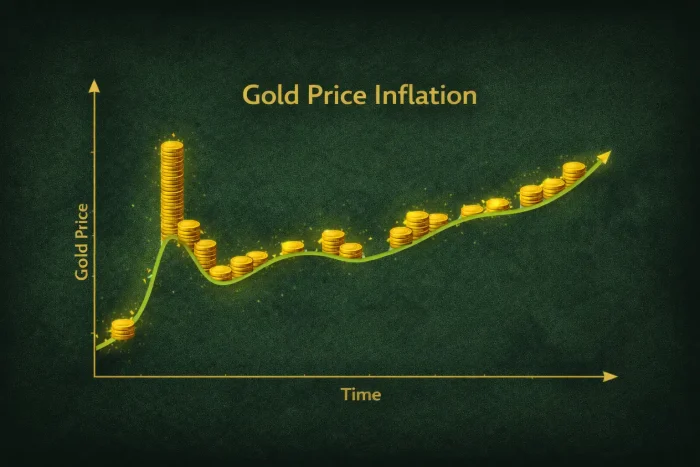
Inflation Drift and Gold Supply Expansion
Inflation in TBC Anniversary follows a predictable pattern:
Early scarcity spike (Weeks 1–3)
Temporary stabilization (Weeks 4–8)
Gradual inflation drift (Weeks 9+)
As more players reach level 70 and optimize farming efficiency, raw gold enters circulation at higher rates. Even if material supply improves, overall currency volume increases. This creates long-term upward pressure on pricing.
Detailed projections are examined in TBC Anniversary Gold Inflation Forecast (Q2 2026), but the core principle is this:
Liquidity pressure does not disappear. It transforms.
Understanding inflation timing allows players to sequence major purchases strategically.
Server Population and Volatility
Server size significantly impacts gold behavior.
High-population servers typically exhibit:
Faster material turnover
Higher volatility during launch
Sharper inflation drift
Greater node competition
Low-population servers tend to show:
Slower turnover
Lower volatility
Wider price spreads
Reduced liquidity
Population effects on gold pricing are analyzed further in How Server Population Affects WoW Gold Prices in 2026.
On competitive servers such as Spineshatter, rapid material turnover can amplify early price spikes. Tracking Spineshatter Gold trends provides valuable insight into phase-based volatility.
Consolidated 90-Day Gold Exposure Table
| Category | Estimated Cost (90 Days) |
|---|---|
| Normal Flying | 1,000g |
| Epic Flying (optional early) | 5,000g |
| Profession Leveling | 1,500–4,000g |
| Pre-Raid Optimization | 800–1,500g |
| Raid Consumables (12 weeks) | 5,000–6,000g |
| Reputation Costs | 900–1,800g |
| PvP Exposure (if active) | 3,000–4,800g |
Total potential exposure for aggressive players can exceed 15,000 gold within the first three months.
This does not mean every player must hold that amount in advance. It means sequencing and income generation determine stability.
Time vs Gold: The Real Cost of Maintaining Raid-Ready Liquidity
One of the most misunderstood aspects of TBC Anniversary gold pressure is not total cost, but time allocation. Many players focus exclusively on how much gold they need without evaluating how much time they must invest to sustain recurring burn.
Let us model realistically.
If weekly raid burn averages 500 gold and average farming yield sits between 150–200 gold per hour, a player must dedicate approximately:
500 ÷ 175 ≈ 3 hours per week
That calculation assumes:
No profession switching
No major enchant upgrades
No epic flying savings
No PvP participation
If additional optimization is pursued, required farming time can easily increase to 5–6 hours weekly.
For players with limited availability — 6–8 total play hours per week — this creates structural tension. Half of available time may be consumed by income generation rather than progression.
This is where gold planning transitions from abstract budgeting to time economics.
Some players accept farming as part of the gameplay loop. Others prefer allocating limited time directly toward raids or Arena. Within this context, evaluating broader WoW TBC Gold market conditions becomes less about urgency and more about opportunity cost.
Time is the hidden currency inside TBC Anniversary.
Understanding how you want to allocate it determines how much gold you realistically need in reserve.
First 30 Days Blueprint: Surviving Early Expansion Without Going Broke
The first month of TBC Anniversary determines long-term liquidity stability. Most gold stress originates from poor sequencing rather than insufficient starting capital.
A structured first 30-day plan reduces compression risk dramatically.
Week 1–2: Infrastructure Phase
Prioritize normal flying immediately.
Level only one profession.
Avoid overpaying for early inflated materials unless essential.
Begin farming routine before committing to epic flying.
The goal is to establish income flow before major capital commitments.
Week 3–4: Controlled Optimization Phase
Complete essential enchants.
Begin moderate raid consumable stocking.
Monitor material price stabilization.
Continue building liquidity buffer.
Only after consistent weekly income is established should epic flying be purchased.
Players who rush epic flying without a structured farming plan often experience avoidable liquidity deficits during Week 3–4.
Strategic sequencing reduces the need for reactive liquidity decisions later in the phase.
Gold Planning Checklist for TBC Anniversary
Before committing to any major gold decision, ask the following:
Liquidity Questions
Do I have at least 4 weeks of raid consumables saved?
Can I sustain weekly burn without emergency farming?
Is my profession investment likely to generate returns?
Timing Questions
Are material prices still inflated from launch?
Would waiting 2 weeks reduce total exposure?
Is inflation drifting upward or stabilizing?
Playstyle Questions
How many hours can I realistically farm weekly?
Am I optimizing for speed or stability?
Is my gold allocation aligned with my raid goals?
This checklist alone prevents most mid-phase liquidity crises.
Common Myths About Gold in TBC Anniversary
Misconceptions often amplify financial stress unnecessarily.
Myth 1: “If I don’t buy epic flying immediately, I fall behind permanently.”
Reality: Epic flying is a productivity multiplier, not a mandatory launch-day purchase. Delaying it until income stabilizes reduces deficit risk.
Myth 2: “Gold is harder to earn than in Classic.”
Reality: Raw gold generation improves in Outland. What changes is synchronized spending pressure.
Myth 3: “Only hardcore players need large gold reserves.”
Reality: Casual players often feel liquidity stress faster because they have less weekly time to offset recurring burn.
Myth 4: “Inflation only hurts poor players.”
Reality: Inflation benefits early investors and asset holders. Players who sequence investments intelligently often outperform inflation drift.
Understanding these myths reframes the entire gold discussion from panic to planning.
Preparing for Phase Transitions: The Overlooked Gold Spike
Another critical liquidity moment occurs before new raid phases.
When Phase 2 or Phase 3 launches:
Consumable demand spikes
Enchant materials inflate
Crafted gear components surge
PvP optimization intensifies
Players who enter new phases with low liquidity frequently experience sharp price exposure.
Maintaining a 2,000–3,000 gold buffer before major content releases dramatically reduces phase-transition stress.
Monitoring broader WoW Anniversary Gold conditions during these transition windows provides insight into inflation acceleration patterns without requiring reactive decisions.
Preparation always costs less than urgency.
Long-Term Stability: Wealth Compounds When Sequenced Correctly
TBC Anniversary rewards disciplined sequencing.
Players who:
Establish early income flow
Avoid peak inflation purchases
Control weekly burn
Time epic flying strategically
often find themselves gaining liquidity by Month Three rather than losing it.
At that stage, inflation drift begins favoring asset holders. Profession investments pay off. Gathering routes stabilize. Guild structures consolidate.
Gold becomes less about survival and more about optimization.
This is the difference between entering Phase 3 stressed versus stable.
Casual vs Hardcore Gold Requirements in TBC Anniversary
Not every player experiences the TBC Anniversary gold economy in the same way. Liquidity pressure varies dramatically depending on playtime, ambition, and optimization level. The difference between feeling stable and feeling constantly behind often has less to do with total wealth and more to do with burn rate relative to available time.
Casual Players (1–2 Hours Per Day)
Casual players typically:
Raid 1–2 nights per week
Participate lightly in PvP
Avoid dual crafting early
Delay epic flying
Their primary exposure comes from:
Normal flying
Single profession leveling
Moderate raid consumables
Limited reputation spending
For this group, a realistic comfortable entry range is:
4,000–6,000 gold
Below this range, liquidity compression becomes noticeable during the first month. Above it, players can absorb early inflation spikes without immediate stress.
Casual players often struggle because their weekly gold burn (300–400g) competes directly with limited farming time. This structural tension is explored in detail in Why Casual Players Struggle in TBC Anniversary.
Active Raiders (3–4 Nights Per Week)
Active raiders face significantly higher recurring burn due to:
Full consumable expectations
Wipe-heavy progression
Complete enchant optimization
Reputation acceleration
For this group, entering TBC with less than 7,000 gold typically results in early liquidity stress.
A comfortable stability zone is:
7,000–10,000 gold
This range allows players to:
Secure normal flying
Level at least one profession
Absorb 6–8 weeks of raid burn
Maintain buffer for unexpected expenses
Without steady income generation, however, even 10,000 gold can compress by Month Two.
Expansion Phase Economics: How Gold Pressure Changes After Month Two
One of the biggest mistakes players make when estimating gold requirements in TBC Anniversary is assuming that early-phase pressure remains constant throughout the expansion. In reality, gold demand shifts dramatically between phases, and understanding this shift is essential for long-term planning.
Phase 1 (Launch – Karazhan / Gruul / Magtheridon)
During the first raid tier, gold pressure is at its peak because multiple systems activate simultaneously:
Flying mount purchases
Profession rush to 375
Crafted pre-raid BIS demand
Heroic key unlocks
Heavy raid wipe cycles
Consumable inflation due to limited supply
This is the capital compression stage. Liquidity buffers shrink quickly.
Phase 2 (SSC / TK)
By the time players reach Serpentshrine Cavern and Tempest Keep, several economic variables have shifted:
Most active players already own epic flying
Profession leveling demand declines sharply
Material supply stabilizes
Gathering efficiency increases
Farming routes are optimized
However, raid difficulty increases. This produces a different form of gold pressure: extended wipe cycles.
Consumable burn often increases during new raid releases because progression lengthens. Even though material supply improves, total weekly spending may rise due to longer raid nights.
Gold pressure shifts from capital investment to operational burn.
Phase 3 (Black Temple / Hyjal)
At this stage, the server economy has matured:
Gold supply is significantly larger
Inflation drift becomes visible
GDKP activity increases
Guild wealth concentration becomes noticeable
Players who accumulated early assets now benefit from inflation. Those who entered undercapitalized often feel permanently behind.
This is where structured planning early in the expansion pays long-term dividends.
Full Pre-Raid BIS Gold Exposure Modeling
To understand total early exposure more clearly, let’s model a hypothetical pre-raid optimized character.
Example Caster Pre-Raid Exposure
Normal flying: 1,000g
Profession leveling (Tailoring): 2,000g
Crafted Spellfire pieces: 2,500g
Enchants (8–10 slots): 900g
Gems: 500g
First month consumables: 2,000g
Total early exposure: ~8,900g
This does not include epic flying.
Adding epic flying increases exposure to ~13,900g.
This demonstrates why entering TBC with 3,000 gold while planning aggressive optimization is structurally incompatible.
Gold Per Hour Breakdown by Method
Not all farming is equal. Realistic early expansion yields:
Gathering (Herbalism / Mining)
150–250g/hour depending on server competition and flying speed.
Dungeon Farming (Solo or Duo)
120–180g/hour, highly class-dependent.
Auction House Flipping
Variable. High risk, high reward. Requires capital.
Daily Quest Loops (Later Phases)
100–150g/hour stable, low volatility.
The most efficient gold strategy often combines:
2–3 hours weekly gathering
Opportunistic Auction House flips
Controlled consumable usage
For a full breakdown, see How Much Gold Can You Farm Per Hour in TBC Anniversary?

Guild-Level Gold Flow and Economic Stratification
An overlooked aspect of TBC Anniversary is guild-level wealth pooling.
In organized guilds:
Materials are sometimes distributed
Crafting is coordinated
GDKP raids redistribute gold
Wealth concentrates among core raiders
Over time, this creates economic stratification:
Early investors benefit from inflation
Casual players experience relatively slower growth
Hardcore raiders accumulate disproportionate liquidity
Understanding this dynamic helps explain why some players feel permanently behind in the TBC gold market.
Advanced Investment Timing Strategy
Optimal sequencing in TBC Anniversary often looks like this:
Purchase normal flying immediately.
Level one income-oriented profession.
Establish consistent weekly farming routine.
Build liquidity buffer to 3,000–4,000 gold.
Purchase epic flying.
Transition into second crafting profession.
This sequencing minimizes deficit windows and maximizes ROI timing.
Hardcore / Min-Max Players
Hardcore players often:
Purchase epic flying immediately
Level dual crafting professions
Optimize enchants aggressively
Raid heavily
Participate in Arena seriously
Their exposure across 90 days can exceed 15,000 gold if all optimization paths are pursued simultaneously.
For this group, a realistic comfort threshold begins around:
10,000–15,000+ gold
This does not imply that every hardcore player must start with that amount. It means that without strategic sequencing, high optimization ambitions quickly outpace liquidity.
The Most Expensive Mistakes in TBC Anniversary
Many players do not go broke because gold is impossible to earn. They go broke because of sequencing errors. The following mistakes consistently create unnecessary liquidity stress:
1. Purchasing Epic Flying Too Early Without Income Plan
Epic flying is powerful, but purchasing it before establishing a farming routine often creates immediate deficit. Players who commit 5,000 gold without a structured recovery plan frequently feel constrained within two weeks.
2. Leveling Dual Crafting During Peak Inflation
Rushing two expensive professions during Weeks 1–2 maximizes material costs. Waiting even 2–3 weeks can reduce total exposure significantly as supply stabilizes.
3. Over-Optimizing Before Progression Requires It
Not every enchant must be best-in-slot during pre-raid content. Incremental upgrades preserve liquidity.
4. Ignoring Recurring Burn
Players often focus on milestone purchases while underestimating 500g weekly consumable drain. Over 12 weeks, this equals epic flying.
5. No Farming Time Allocation
Without allocating at least 2–4 hours weekly toward income generation, mid-phase compression becomes inevitable.
Understanding these pitfalls is often more valuable than simply accumulating more gold.
Gold Spending Priorities Framework
To maintain stability, spending should follow a structured hierarchy:
Normal flying (mandatory infrastructure)
Single profession leveling
Pre-raid essential enchants
Establish weekly farming routine
Build liquidity buffer
Then pursue epic flying
Then consider dual crafting or luxury upgrades
This sequencing reduces early deficit risk dramatically.
For players evaluating time-versus-value tradeoffs, Gold Farming vs Buying in TBC Anniversary provides a neutral comparison model.
Within this context, some players monitor broader WoW TBC Gold pricing trends before major progression milestones, particularly during peak inflation windows.
Planning liquidity is not about impulse decisions. It is about structured timing.
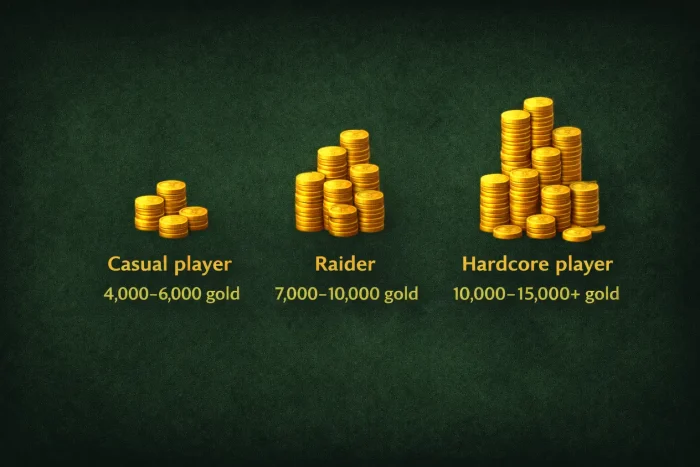
Final Gold Requirement Summary
To consolidate all modeling:
| Player Type | Comfortable Entry Range |
|---|---|
| Casual | 4,000–6,000g |
| Active Raider | 7,000–10,000g |
| Hardcore / Min-Max | 10,000–15,000+g |
These figures reflect:
Mount investments
Profession exposure
12-week raid burn
Reputation spending
PvP participation
Inflation timing
They are not mandatory thresholds. They are stability ranges derived from realistic 90-day modeling.
FAQ:
Is gold harder to earn in TBC Anniversary?
Not inherently. Raw gold generation improves compared to Classic. However, synchronized demand and compressed spending create the perception of scarcity.
Should I buy epic flying immediately?
Only if you have a clear farming strategy or significant liquidity buffer. Otherwise, delay until income stabilizes.
Why does gold matter more in TBC than Vanilla?
Because TBC introduces multiple capital sinks simultaneously: flying, professions, crafted gear, and ongoing consumables.
How much gold do raids actually require?
A realistic weekly burn ranges from 400–600 gold for active progression. Over a full phase, that often exceeds 5,000 gold.
Does server population affect gold pressure?
Yes. High-pop servers experience sharper volatility and inflation drift. Monitoring population trends helps anticipate price swings.
Gold Is Tempo Control in TBC Anniversary
TBC Anniversary does not punish poor players. It punishes unprepared ones.
Mounts convert gold into mobility.
Professions convert gold into power.
Consumables convert gold into consistency.
Reputation converts gold into access.
Gold is not about hoarding excess. It is about maintaining tempo control across conversion cycles.
Players who understand capital compression, recurring burn, and inflation timing experience smoother progression. Players who treat early liquidity casually often encounter mid-phase instability.
For those prioritizing efficiency during heavy progression windows, observing the broader WoW Anniversary Gold landscape and server-specific conditions such as Spineshatter Gold trends can help align major purchases with favorable timing.
Preparation, not panic, defines long-term stability.